
How to Run a School-Wide Mental Health Screening Programme (Without Overwhelming Your Staff)
Screening only creates value when it is tied to capacity, consent and follow-up. A step-by-step operational blueprint for school leaders introducing universal wellbeing screening.

On this page
- What Screening Is — and What It Is Not
- The three questions screening should answer
- Step 1: Build the Response Pathway Before the Questionnaire
- Step 2: Choose Instruments That Match Your Purpose
- Age banding, briefly
- Step 3: Consent, Privacy and the Trust Problem
- Data governance checklist
- Step 4: Prepare Staff Before You Prepare the Forms
- A worked scenario
- Step 5: The Screening Calendar
- Step 6: Turn Data Into Decisions
- Common Failure Modes
- Frequently Asked Questions
- Does screening make students more anxious?
- Are we qualified to do this without a psychologist?
- What if parents refuse?
- How do we handle a risk disclosure found in the data?
- Should screening results be shared with next year''s teachers?
- Key Takeaways
- Related Reading
- Bring structure to your wellbeing programme
Most schools discover student distress by accident. A teacher notices a child who has stopped speaking in class. A parent calls after a difficult weekend. A counsellor is pulled into a crisis that had been building for eleven months. By the time the adults act, the problem is expensive — emotionally for the child, operationally for the school.
Universal screening changes that arithmetic. Instead of waiting for behaviour loud enough to be noticed, the school asks every student a short, structured set of questions on a predictable schedule, and reads the answers as a system rather than as isolated incidents.
But screening is also where well-intentioned schools fail most often. They buy a questionnaire, run it once, generate 180 flagged students, discover they have one counsellor and no referral pathway, and quietly never run it again. Screening without capacity is not care — it is a liability.
This guide is the operational blueprint: how to design, launch and sustain a school-wide screening programme that your staff can actually carry.
💡 The governing rule. Never screen for more than you can respond to. Programme design starts with your response capacity, not with your questionnaire.
What Screening Is — and What It Is Not
Screening is a population-level triage tool. It sorts a whole cohort into broad bands of likely need so that limited professional time reaches the right children first.
Screening is not:
- A diagnosis. A raised score means "look closer", never "this child has anxiety".
- A performance measure for teachers or classes.
- A permanent label to be carried in a student's file.
- A substitute for relationships, observation or clinical judgement.
The distinction matters legally and culturally. Schools that market screening internally as "finding the children with problems" generate staff anxiety and parent resistance. Schools that frame it as "a routine wellbeing check, like a vision test" get participation rates above 90%.
The three questions screening should answer
- Who needs a closer look this term? (individual triage)
- Where are the pressure points in our school? (Year 9 boys, the transition cohort, the hostel students)
- Is what we are already doing working? (comparison across screening cycles)
Most schools only design for question one and then wonder why leadership finds the data uninteresting.
Step 1: Build the Response Pathway Before the Questionnaire
Start at the end. Draw the journey a flagged student will take, and staff it.
A workable minimum pathway has four tiers:
| Tier | Who it covers | Typical response | Who owns it |
|---|---|---|---|
| Universal | All students | Classroom wellbeing practice, SEL, safe adults | Class teachers |
| Emerging | Mild elevation, ~10–15% | Teacher check-in conversation, monitoring for 4–6 weeks | Form tutor + wellbeing lead |
| Targeted | Moderate elevation, ~5–8% | Structured counselling block, parent meeting, learning adjustments | School counsellor |
| Acute | Risk indicators, ~1–2% | Same-day safeguarding response, external referral | Safeguarding lead + leadership |
Now do the maths for your own school. If you have 900 students, tier three alone will produce roughly 45–70 children. At six sessions each, that is 300–400 counselling hours in a year. One counsellor working 15 direct hours a week has about 500. The numbers only work if tiers one and two are genuinely absorbing the majority of need.
If they cannot, you have three honest options: increase capacity, narrow the screen to one year group at a time, or raise the threshold for tier three and be explicit that you are doing so.
⚠️ A pathway that exists only on paper is worse than no pathway. Once you ask a child how they feel and they tell you truthfully, you have created an expectation of response. Unanswered disclosures teach students that adults do not follow through.
Step 2: Choose Instruments That Match Your Purpose
Schools rarely need one instrument. They need a small, deliberate set.
- Broad wellbeing / difficulties measure for the universal sweep — short, age-banded, and validated for the population you serve.
- Domain-specific follow-up (anxiety, mood, attention, behaviour) applied only to students flagged by the broad measure.
- Teacher-report companion for primary years, where self-report reliability is lower.
- A risk protocol, separate from the screen, triggered by any item touching self-harm.
Selection criteria that matter in practice:
- Completion time. Under 10 minutes for the universal sweep, or you will lose lesson time and goodwill.
- Reading level and language. Instruments must be available in the language of instruction and the home language for younger students. Translate poorly and you measure literacy, not wellbeing.
- Cultural fit. Items about "going out with friends" or "family dinners" behave differently across communities. Pilot on 30 students and ask them which questions felt strange.
- Licensing. Confirm you may use it for the number of students you have, digitally, and that scoring rules are documented.
Age banding, briefly
- Ages 5–8: teacher and parent report, plus simple pictorial self-report on feelings.
- Ages 9–13: short self-report with a teacher companion form.
- Ages 14–18: self-report only, with strong confidentiality framing — adolescents under-report when they believe teachers read individual answers.
Step 3: Consent, Privacy and the Trust Problem
The fastest way to lose a screening programme is to surprise parents.
Decide your consent model deliberately:
- Opt-out (informed dissent). Parents are notified with full detail and may withdraw their child. Yields high coverage, appropriate for low-intrusion wellbeing measures. Requires genuinely clear notice — not a line buried in a handbook.
- Opt-in. Explicit signed consent. Ethically safest for anything touching mental health symptoms, but coverage typically falls to 40–60%, and the families who do not return forms are frequently the families whose children most need the screen.
Whichever you choose, publish six things in plain language: what is asked, who reads it, how it is stored, how long it is kept, what triggers a call home, and how to withdraw.
Data governance checklist
- Named data owner (usually the wellbeing or safeguarding lead)
- Access list — who can see individual scores, and who sees only aggregates
- Storage in a controlled system with per-role access, never in a shared spreadsheet or a personal drive
- Defined retention period and a deletion date
- Written rule that screening data never enters academic records, references or discipline files
- Aggregate-only reporting to the board and to staff meetings
📖 Student assent still matters. Even with parental consent, tell students they may skip any question. A screen completed under compulsion produces unusable data and damages the relationship you are trying to build.
Step 4: Prepare Staff Before You Prepare the Forms
Two hours of preparation prevents a term of confusion. Cover four things:
1. Why we are doing this. Give teachers the school''s own numbers: how many crisis referrals last year, how late they arrived, what they cost in disruption.
2. What teachers will and will not see. Most staff should see class-level summaries and a list of students to keep an eye on — not raw symptom scores. This is a protection for both the child and the teacher.
3. How to hold a check-in conversation. The single highest-value skill in the whole programme. Practise a five-minute structure: notice something specific, ask an open question, listen without solving, name the next step, close warmly.
4. What to do with a disclosure. One page, laminated, in every staffroom: what to say, who to tell within the hour, what never to promise (secrecy), and what to write down.
A worked scenario
Year 8. The screen flags Aarav in the emerging band: low mood items elevated, no risk indicators. His form tutor holds a check-in.
Tutor: "I noticed you''ve been finishing work early and then putting your head down. That''s different from last term. How are things going?"
Aarav: "Fine. Just tired."
Tutor: "Tired how — sleep, or the kind of tired where everything feels like effort?"
Aarav: "…the second one."
That exchange takes ninety seconds and is worth more than the questionnaire that prompted it. The screen''s job was only to tell the tutor where to spend those ninety seconds.
Step 5: The Screening Calendar
Run twice a year, not once. A single annual screen tells you nothing about change.
- Weeks 1–2 (Term 1): staff briefing, parent notice, consent window.
- Week 4: universal screen, delivered in a fixed pastoral slot across all classes on the same two days.
- Week 5: scoring, banding, safeguarding triage of any risk flags within 24 hours.
- Weeks 6–8: tier-two check-in conversations; tier-three intake appointments.
- Week 9: aggregate report to leadership; one decision made from it.
- Term 2, Week 4: repeat screen for previously flagged students only.
- Term 3, Week 4: full re-screen; compare cycles.
Fixing the dates in the school calendar in advance is what turns screening from a project into a routine.
Step 6: Turn Data Into Decisions
The aggregate report should fit on one page and answer three questions: what changed, where is the concentration, and what will we do differently.
Patterns worth acting on:
- A single year group spiking. Usually structural — a timetable change, a new exam load, a cohort transition. Fix the structure, not the children.
- Sleep and fatigue items dominating. Look at homework volume, start times, device policy and coaching-class schedules before you look at pathology.
- Peer-relationship items concentrated in one class. A social dynamics issue for the class teacher and pastoral team, not fifteen individual referrals.
- Flat scores everywhere. Suspect the delivery, not the students — students who believe answers are not confidential give uniformly neutral responses.
✅ Make one visible change per cycle. Staff and parents sustain a programme they can see working. "We moved Year 10 assessments apart after the last screen" is more persuasive than any policy document.
Common Failure Modes
| Failure | Early signal | Correction |
|---|---|---|
| Over-referral | Counsellor waitlist exceeds a term | Raise tier-three threshold; strengthen tier-two conversations |
| Under-participation | Coverage below 75% | Move to opt-out with clearer notice; run in a supervised class slot |
| Data drift | Scores stored in three places | Single system, one owner, per-role access |
| Staff fatigue | Check-ins not completed | Cap check-ins per tutor at three per cycle |
| Loss of trust | Students report answers were discussed publicly | Re-brief staff; publish who can see what |
Frequently Asked Questions
Does screening make students more anxious?
Evidence from school-based programmes consistently shows the opposite: being asked about wellbeing in a structured, non-judgemental way does not induce distress, and asking directly about self-harm does not increase it. What does cause harm is asking and then not responding.
Are we qualified to do this without a psychologist?
Schools can administer a validated wellbeing screen with trained staff. What requires professional involvement is interpreting elevated scores, managing risk, and any onward clinical work. If you have no psychologist on staff or contract, run the screen only at tiers one and two and establish a referral relationship with an external service before you begin.
What if parents refuse?
Record the withdrawal, do not screen the child, and continue normal pastoral observation. Refusal rates above 15% usually indicate a communication problem — hold a parent information evening rather than pushing the forms harder.
How do we handle a risk disclosure found in the data?
Treat it as a safeguarding event, not a screening result. Same-day contact with the student, immediate involvement of the safeguarding lead, parent contact unless doing so increases risk, and a written record. Your risk protocol should be finalised before the first questionnaire goes out.
Should screening results be shared with next year''s teachers?
Share the plan, not the scores. A handover note saying "benefits from a check-in on Monday mornings; sensitive to unstructured time" is useful. A symptom score from eight months ago is not.
Key Takeaways
- Design your response pathway and count your capacity before selecting an instrument.
- Screening is triage, not diagnosis; separate risk protocols from wellbeing screens.
- Consent, storage, access and retention decisions must be written down and published.
- Teacher check-in conversations, not questionnaires, are the mechanism that helps children.
- Screen twice a year, report in aggregate, and make one visible change per cycle.
Related Reading
- Understanding Student Mental Health in Schools — the classroom-level foundation this programme sits on
- Creating Emotionally Safe Classrooms — the tier-one practice that reduces tier-three demand
- Why School Counselling Matters — building the capacity screening depends on
Bring structure to your wellbeing programme
TherapickMind School Connect gives schools one secure platform for screenings, RAG banding, referrals, counselling records, IEPs and professional reporting — with role-based access so teachers, counsellors and leaders each see exactly what they should.
If you are planning a screening programme for the coming academic year, request a School Connect demonstration or write to schools@therapickmind.com. We will walk through your capacity numbers with you before you choose an instrument.
Irshad Mahammad
Founder, TherapickMind · Consultant Psychologist · Assistant Professor of Psychology
Irshad Mahammad is a Consultant Psychologist and Founder of TherapickMind, dedicated to improving student wellbeing through evidence-based psychological services, school mental health programs, counselling and psychological assessments. His work supports schools through early identification, student wellbeing initiatives, Individualized Education Plans (IEPs), teacher training and evidence-based interventions.
Ready to build a healthier, more supportive school?
Discover how TherapickMind School Connect helps schools manage screenings, interventions, student wellbeing, IEPs and professional reporting from one secure platform.
Related articles
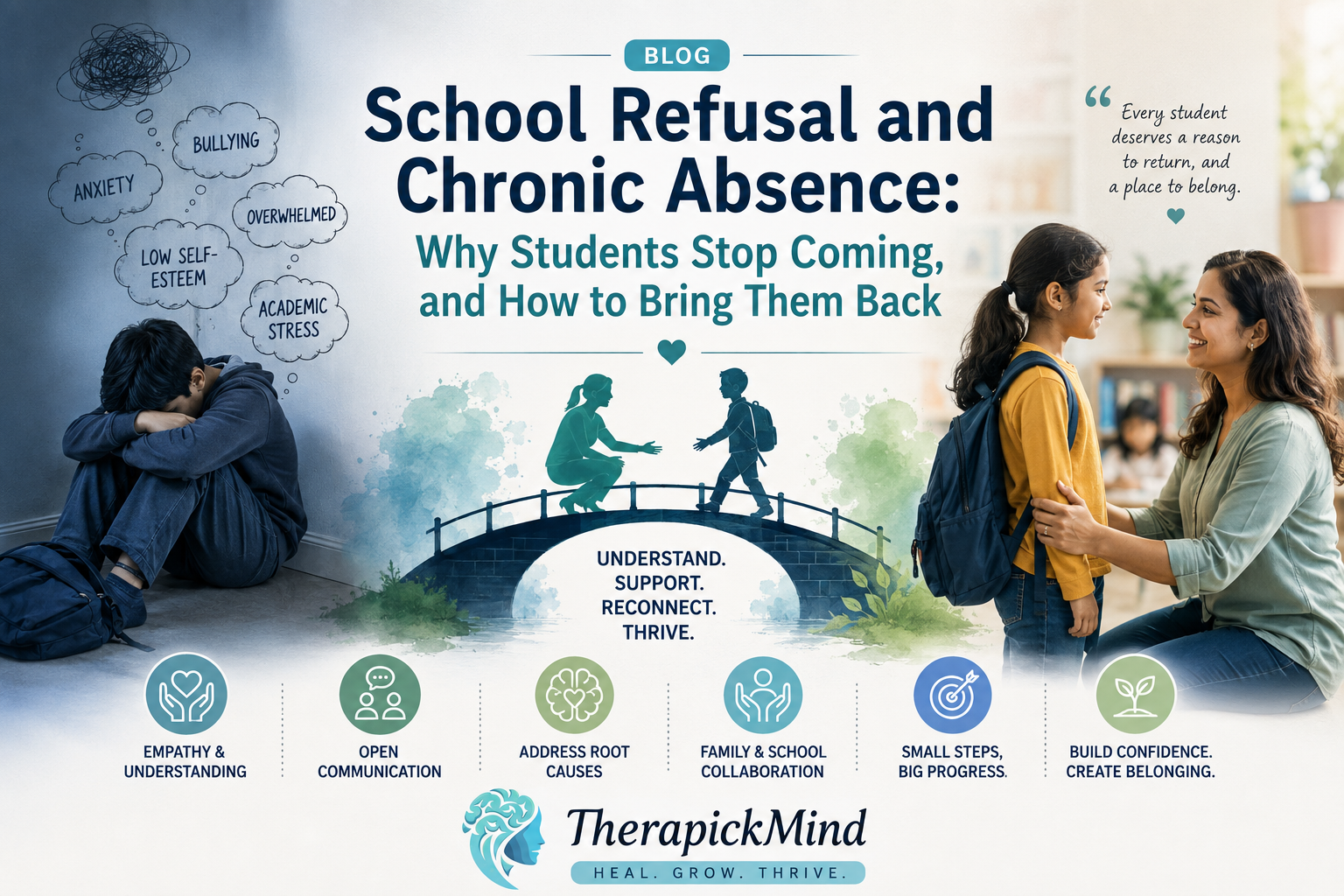
Chronic absence is rarely about laziness. A diagnostic framework for schools and parents to identify the real driver behind non-attendance and build a graded return plan that holds.

Every school needs a qualified counsellor — not as a luxury, but as core infrastructure. Why, and what a strong programme looks like.